
First confirm what format your manga is
Local manga is most commonly found as CBZ, CBR, ZIP, RAR, PDF, EPUB, MOBI, and image folders. Before choosing a reader, count which formats you actually have the most of, so you don't install something that can't open your main formats.
Experience varies a lot by format; in brief:
- EPUB, MOBI: e-book standards; page order is usually defined by the internal structure and stays stable. MOBI comes mainly from the Kindle ecosystem; iOS readers can open it directly, but support is less universal than EPUB. Whether the cover is picked up depends on the resource's own metadata.
- ZIP, CBZ: essentially image archives, transparent and quick to open, and easy to manage. Covers are usually recognized by the reader from the images; results vary by resource and reader.
- PDF: opens on almost every device, but it's designed for print, so scans often carry white margins that need cropping.
- RAR, CBR, 7Z: older archive formats; some resources are encrypted or split into volumes, and reader support varies.
For the full trade-offs between formats, see which manga format should you choose; to evaluate resource quality from various channels, see where to find manga resources.
Put manga on the bookshelf
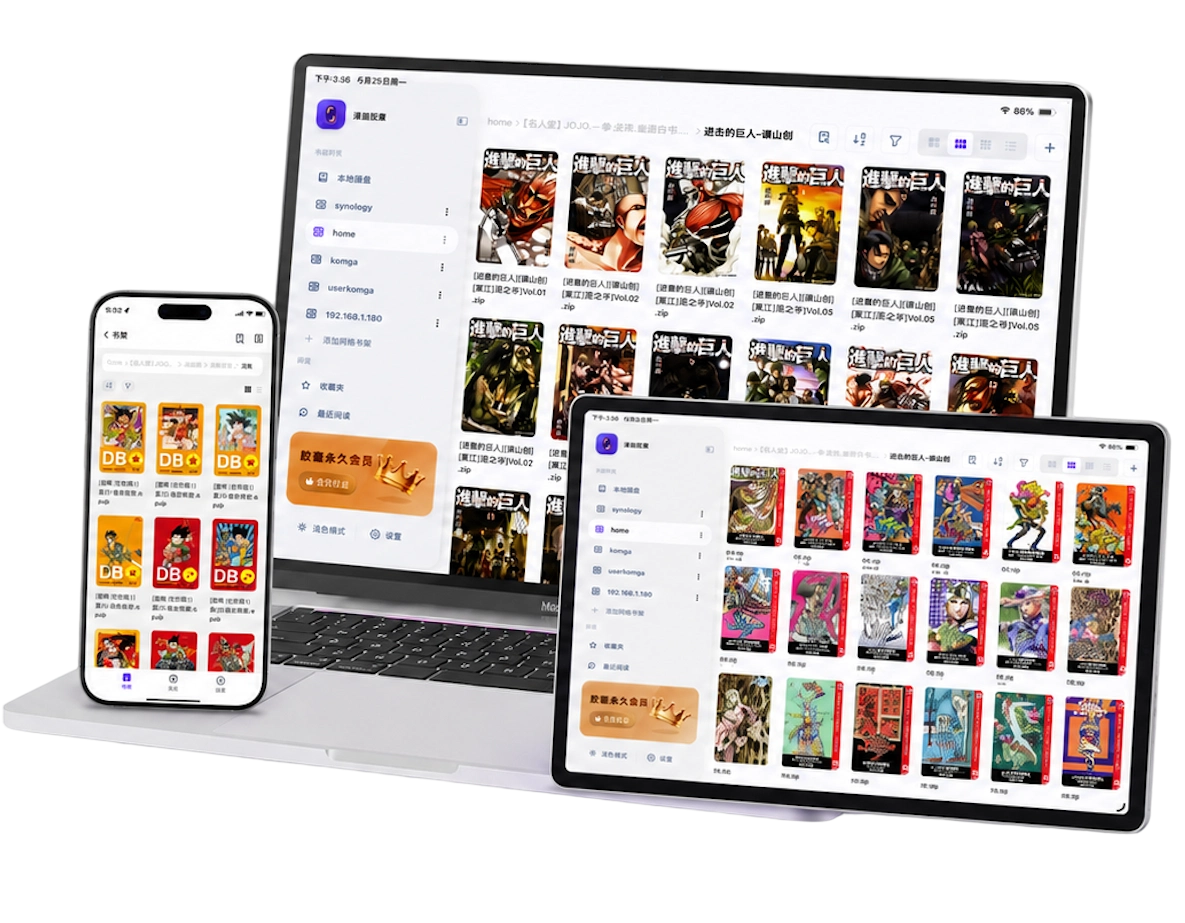
Once the format is confirmed, import the files into the reader. Using Manga Capsule as an example, there are four common ways:
- Import from the Files app: when the manga is already on the iPhone/iPad or in iCloud Drive, tap "+" → import file/folder.
- Wi-Fi transfer: with the device and computer on the same network, open the address the app shows in a browser and drag files in for batch transfer.
- USB wired import: connect the Mac with a cable and drag files into Manga Capsule in Finder.
- Share from another app: when you receive a file in WeChat/QQ/browser, use the share sheet to send it to Manga Capsule.
Step-by-step instructions are in how to read local manga with Manga Capsule. For MOBI/AZW3 exported from Kindle devices, see what to do with manga after Kindle exits the market.
Local vs cloud: how the two storage types work together
The biggest advantage of local storage is offline reliability: the files are on the device, so they read even without a network and work fine on unstable connections.
The cost is device space, so the common approach is to combine the two:
- Keep the few titles you read often or need offline on the device;
- Put a several-hundred-GB archive on a NAS or cloud drive, and read it through a reader that supports on-demand page loading — you save device space and trade it for network wait time and cache usage.
These two approaches are the difference between a "local manga reader" and a "NAS manga reader." If your library is already large, see the NAS manga reader guide and move the collection that is eating your device space to a shared folder.
Reading experience: tune every book until it is comfortable
Importing is just the start; making books "comfortable to read" is the reader's real job. Common options:
- Split spread pages and merge cross-page spreads: cut scanned two-page images into single pages, and stitch cross-page spreads back into one complete image. See how to split scanned manga pages and merge double-page spreads.
- Crop white margins: auto-crop and fill the screen when a scanned PDF has wide borders. See how to remove excess white borders from PDF comics.
- Reading direction: Japanese manga right-to-left, Western and Chinese page-manga left-to-right, webtoons top-to-bottom, remembered per book.
- AI enhancement: when old scans are blurry, use the on-device model to sharpen; the processing happens on the device and doesn't depend on the network.
If you're about to enjoy a bigger screen on the iPad, see the complete iPad manga reader guide, which covers folders, formats, and reading modes as a whole.
Frequently asked questions
A local comic won't open after importing. What are the common causes?
Four common causes: what a cloud drive shared was a shortcut rather than the full file, the download was incomplete, the archive is encrypted, or an archive nests another archive. The step-by-step fix is in common causes of file corruption.
Can an image folder (a bunch of JPG/PNG) be read as a comic?
Yes, but the experience is usually worse: a folder has no built-in title, cover, or volume information, so the reader has to guess from filenames, and sorting, covers, and progress tracking are hard to guarantee. For such resources, package them into ZIP or CBZ on a computer before importing for more stable results.
Do I need to convert all formats into one before importing?
No. Manga Capsule reads the common formats above directly — no need to unzip or convert. Only unusual compression or encrypted files need extra handling.
Is this page for people looking for online manga?
This page is about reading manga files you already own. Manga Capsule does not provide online manga content; use files and services you are entitled to read.